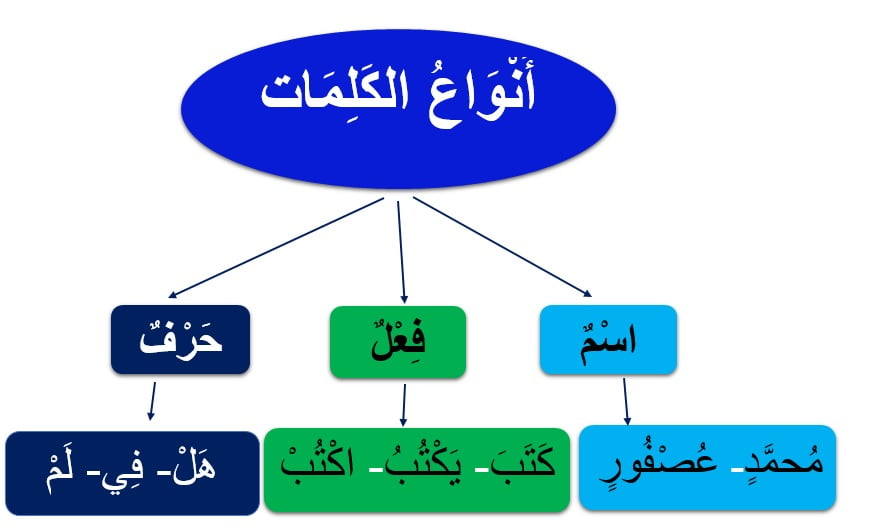
The three Parts of Speech in the Arabic Language .Noun اسم , Verb فعل and particle حرف
Arabic contains only three parts of speech, compared to eight in English. Only after the three categories are precisely defined will this discrepancy become evident.
The Types of Word (أَنْوَاع الْكَلِمَاتِ)
| وَتَنْقَسِمُ إِلَى ثَلاَثَةِ أَنْوَاعٍ: نَوْعٍ يُقَالُ لَهُ “فِعْلٌ“، مِثْلُ: “كَتَبَ”، وَ”يَكْتُبُ”، وَ”اُكْتُبْ”، وَنَوْعٍ يُقَالُ لَهُ “اسْمٌ”، مِثْلُ: “مُحَمَّدٍ”، وَ”عُصْفُوْرٍ”، وَ”تُفَّاحَةٍ”، وَنَوْعٍ يُقَالُ لَهُ “حَرْفٌ”، مِثْلُ: “هَلْ”، وَ”فِيْ”، وَ”لَمْ” They (i.e. the الْكَلِمَات ) are divided into three types: A typed called “فِعْل” (verb), like: “كَتَبَ” (wrote), “يَكْتُبُ” (write/will write), and “اُكْتُبْ” (Write!). A type called “اسْم” (noun), like: “مُحَمَّد” (Muhammad), “عُصْفُوْر” (sparrow), and “تُفَّاحَة” (apple), and a type called “حَرْف” (particle), like: “هَلْ” (question article), “فِيْ” (in) and “لَمْ” (did not) |
Description: All terms (الْكَلِمَات) derived from letters in the Arabic Alphabet can only be classified as one of three types:
- a type called fʿil“فِعْل” (verb),
- a type called ism“اسْم” (noun) and
- a type called Haraf “حَرْف” (particle).
- . A few examples of fʿil are:
The الْفِعْل is like:
كَتَبَ (wrote) يَكْتُبُ (write/will write) اُكْتُبْ (Write!)
دَحْرَجَ (rolled) يُدَحْرِجُ (roll/will roll) دَحْرِجْ (Roll!)
اِنْطَلَقَ (went) يَنْطَلِقُ (go/will go) اِنْطَلِقْ (Go!)
اِسْتَخْرَجَ (extracted) يَسْتَخْرِجُ (extract/will extract) اِسْتَخْرِجْ (Extract!)
The fʿil فعل represents an event that occurs at a given point in time and is used for a verb form that describes an action occurring at a particular time.
An ism may refer to anything, including adjectives, pronouns, adverbs, etc.
The ism الاسْم (which includes nouns, pronouns, adjectives, adverbs, etc.)
. A few examples of the ism are:
“مُحَمَّد” (Muhammad),
“عُصْفُوْر” (sparrow),
“تُفَّاحَة” (apple),
“أَرْض” (earth),
“سَمَاء” (heaven, sky),
“شَمْس” (sun),
“قَمَر” (moon), We often refer to other Examples of what We call Nouns, such as People, Mountains, Rivers, Countries, and every other Noun or Word that name some Animal(s), Plant(s), or Inanimate Object(s).
The Haraf الْحَرْف provides many of these words: Prepositional, Interrogative, Negative, Future, Conjunctions, and even future tense. Examples include:
Hal “هَلْ”, (a Question word),
Fii”فِيْ”, (A word meaning “In”, “At”),
Lam “لَمْ”, (a Negative word),
Min “مِنْ”, (The word meaning “From”, “Of”),
Ilaa”إِلَى”, (The word meaning “To”, “Toward”), and
Thuma “ثُمَّ”, ( Translated “Then”, “Afterwards”, “After”).
In addition to these there are many more words which have no meaning unless they are used to modify, qualify, or complete another word
Translated by Jamal Amin