Arabic culture customs and traditions :
Arabic Culture and society, Arab culture clothing
Useful background information about the people whose language you are learning.
The Arabic language and its culture
Greetings are exchanged before any conversation takes place.
The varied, rich culture of the Arab world impacts everything from the individual’s way of speaking, dressing and living, and knowing a little about the culture and the people of the region, where you are studying Arabic, will be beneficial in your studies.
When people meet for the first time, the most common form of greeting is a handshake. In western cultures, a firm grip is generally expected, but this is not the case among Arabs and Muslims, who often consider a soft grip to be the proper way to shake hands (and perhaps not even completely grasping each other’s hands on the first meeting). In western cultures, it has been taught that a person’s worth or character can be determined by the type of handshake they provide, but this should not be assumed to be similar in Arabs and Muslims. In addition, depending on which views are held, there are varying degrees of appropriateness for shaking hands with members of the opposite sex in Arab and Muslim cultures, and the spectrum of beliefs regarding male-female interaction ranges from very conservative to very liberal, and all those in between.
The woman usually determines the appropriate non-verbal greeting for herself during the first encounter with a man. For example: Many conservative women make eye contact or smile at the man. However, many women today are happy to shake hands with a man.
As a result, men should take their cues from the woman and determine the best non-verbal way to greet her. At the same time, it is customary for men to greet each other with a kiss on the cheek when they meet for the first time. Although it may seem strange or awkward at first, you will get used to kissing each other on the cheek as you make new friends.
When a male friend greets a female friend, he should typically give her one kiss on the left side and one kiss on the right side. When two females meet for the first time, they may greet each other with two or more kisses on each side. Perhaps now you can appreciate why females may feel confused about how many times they kiss.
Women who are more liberal or casual in their approach to meeting new friends usually greet their male friends with a kiss on the cheek, just as they would do for their female friends. In this case, the male friend should wait for the female friend to decide what is acceptable for her in terms of a non-verbal greeting. Likewise, female travellers to the Middle East should be aware of the cultural differences between males and females in order to avoid sending the wrong message to Arab males.
Generosity:
Generosity is a cultural norm in the Arab world, and it may catch you off guard on occasion. A simple comment about something you like or want will usually get you an offer of that item from the owner.
Being generous is generally more important to an Arab than having ownership.
When someone offers you something, you should respond to them with a “Thank You” (لأ شُكْرًا) and decline to accept their generosity; we just learned that. If they continue to try and give it to you, especially after trying to give you something four times or more, then you can be assured that they are very serious about wanting to give it to you. It would be offensive to continue to refuse their generosity at that point. To thank someone for their generosity, you can say “شُكْرًا جَزيلًا” (thank you very much). Yes, you guessed it, it means “thank you very much.”
Being Guest
If you are a guest do not be shocked or annoyed if you are taken away from your wife and entertained in different rooms, in Arabian and Islamic Culture men and woman has separate room for entertaining the guests.
Such hospitality is very important to the Bedouin society and reflects the belief that every guest should be able to depend on their goodwill.
Gulf Arabic is somewhat closer to Literary
Arabic although what is left of the Bedouin culture offers a
contemporary understanding of the societal values and conditions which led to the.
to Islam.
Traditional dress: women
Clothing scroll is changing the nature of clothing which was a form of presentation It will not be returned, and the costume The first recorded example of something to do till expiration Throughout human history, after all, because I want to see And it is as long as written remains in history History has always been part of his self- applause.
and ʻimageʼ. Nowhere is this more apparent than from the start
twenty-first century Gulf, where a bit more of the ʻreligiousʼ hue can be said to.
womenʼs dress code than was the case even 20 years ago,and certainly
compared with 40. The everyday costume for Gulf women, even
encountered in the elderly population, is relatively straightforward. A pair of loose-fitting
light cotton trousers,سروال with slim embroidered ankle bands, called
Worn underneath the: sirwaal,alus, a chemise-like garmen three broad pieces of cloth folded in two and sewn together.
one-pieced bodice and skirt with front extending all the way to the knees .
The name of the garment is called darraa3a (pl. daraarIi3), and there are different types of designs. The majority of the time in villages, the fabrics of the darraa3a include simple floral patterned cotton, yet for special events the darraa3a would be a more narrow fit and made from dark material (sometimes black) and have many decorative features on the neckline and narrow sleeves, such as heavy gold embroidery and/or gilded cords.
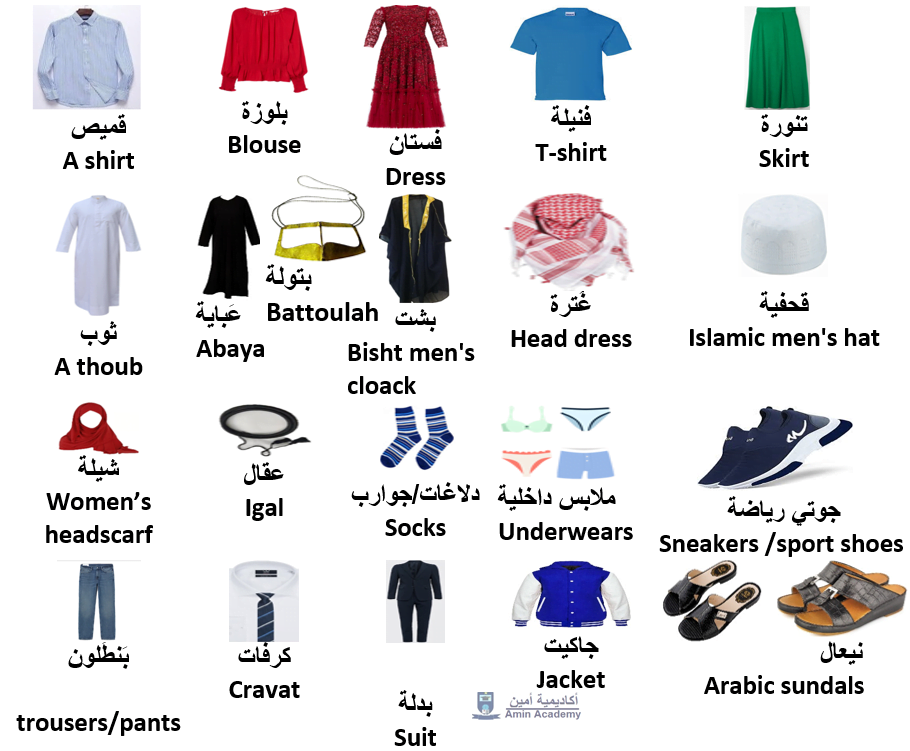
Children under the age of puberty would wear a sirwaal سروال and a simple darraa3a (with a head covering called a bukhnug (pl. bakhaanig), which consisted of a hood that covers the face and a bodice that is waist-length). In contrast, adult females wear an over-dress called an thoob ثوب (which can also be called some other names depending on the type of fabric and decorative style). For example, in Bahrain the thoob-thnashal (soft silk) is bright in color and has very elaborate designs and is worn for weddings, 3iid and other celebrations. In most places outside the home, women wear a simple black silk coat without any decorative features (called an 3aba/3abaaya/daffa [pl. dfaaf]) with most women wearing a face veil. BLACK filigree face
The Islamic term حجاب also covers the concept of ‘hijaab’ ‘modesty’. Therefore, since both men and women have been told to practice modesty, it is mainly women who are encouraged to wear this type of garment. The ‘New Islamic’ Style of Dress has evolved to create a type of long, flowing garment known today in many Arab nations, which consists of one piece of fabric that covers a woman’s entire body, with a headscarf wrapped around her head and tightly pulled over the facial area. The garment usually comes in either white or black. Woman who wear this kind of clothing are referred to as muHajjabaat محجبات ‘covered women’.
Arab Names:
Arabic names typically follow the structure: first name, father’s name, grandfather’s name (example., Khalid Ahmed Omar). Generally, this is true for both men and women. In several areas, most commonly Oman and Saudi Arabia, it is popular to place the word bin, which translates to ‘son of,’ between the 2nd and 3rd name (or bint, meaning ‘daughter of,’ for women, which usually does not change after they marry). The use of bin/bint is generally placed in the correct position within the personal name.
The names of the ruling families in the Gulf region, as well as high-profile individuals, also include clan names.
In this context, the clan name is always included at the end of the complete three-part name or after the first two elements. Although this is not a requirement for some countries, it is a standard convention in many Arab countries, particularly Oman, where it is common to see names of the format shown above.
In police reports, the names of ruling families are reflected in an alternative style of tribal association. In this case, the word “āl” meaning “family” or “(royal) house” prefixed to the family name (example. Al Khaliifa) is the same as “al-” (the definite article) in normal people’s names. Therefore, the name of the current Ruler of Bahrain is:
”Hamad son of 3iisa son of Salman of the House of Khalifa”
Men’s traditional clothing
The men’s traditional clothing worn every day in the Gulf is a long white top, which is usually complemented by a headpiece and a headband (sometimes just called a “head rope”). Different areas in the Gulf States call this long top, by different names based on the way it is designed and cut as well as how its collar is constructed based on where you are. In Kuwait and Oman, it is generally referred to as a dishdaasha, dishdaasha in the plural form. In Bahrain, Qatar and Eastern Saudi Arabia, the name used to describe this top is thoob, thoob in the plural form, which means nothing more than a “dress” and thus can also be used for women’s clothing of the same type. In the United Arab Emirates, the top is called kanduura, kanduura in the plural form. When dressing formally, it is customary for men to wear a lightweight outercoat over the long white top; this outercoat is called a bishtبشت (sometimes spelled bisht). The bisht بشت can be made from brown or black wool and the collar region, the shoulder area and along the front borders of the coat are typically designed with gold threading for its embellishments. For manual labour, including agriculture, fishing or construction work, men typically use a loincloth for protection; this loincloth is called wizaar, wizaar in the plural form. The black or white checked (for moons month of Ramadan) and cotton covering with the red and white checked pattern, produced from the cotton plant, is known as the ghutra غترة(ghutrah) or ghutrah in Arabic language and is placed on top of the head by using a plain white skull cap. The skull cap is also referred to as a ghutra in Arabic language in both Qatar and Bahrain.
The black head rope holding the Ghutra is called the IGAAL (Arabic عقال). The IGAAL is literally termed “tether rope” and when used to tether camels originally, it was a practical place to put it when it was not being used – on the head! Generally speaking, most Egals found in Qatar and the United Arab Emirates have long tassels hanging off the back that go to the middle of a man’s back (or longer).
There are different types of headwear used by Omanis depending on the season. For example, on a daily basis, Omanis typically wear a cotton embroidered cap called a kummaat (other variations include kima, kumma). While all kummaa’s share some common characteristics, each design is distinct to Oman. The mSarr is the headscarf that goes along with the kumma. Most of the time, mSarr’s are made from cotton; however, for special or ceremonial events, mSarr’s may be made from silk. In southern Oman, it is common to find versions of mSarr that are tasselled and are called shmaagh (see image below). The Sultan of Oman and his family are the only people allowed to wear a special kind of headwear called the al-3ama ama s-sa3iidiyya (“Saidi turban”) made from blue, magenta, red, orange, and other colors of silk. This type of headwear is named after the Sultan’s dynasty (the Ġāl Bu Said).
Omani footwear will depend on the season. In the summer months, Omanis wear sandals (or na3al) and in the winter months, Omani’s typically wear British/European-style shoes (juuti, plural of jawaati), which is a borrowed term from India.
What follows are photos of the ghutra/3igaal styles from the Gulf Region, as well as photos of Oman-inspired mSarr and shmaagh, in addition to a photo of an Omani mSarr worn in Oman.